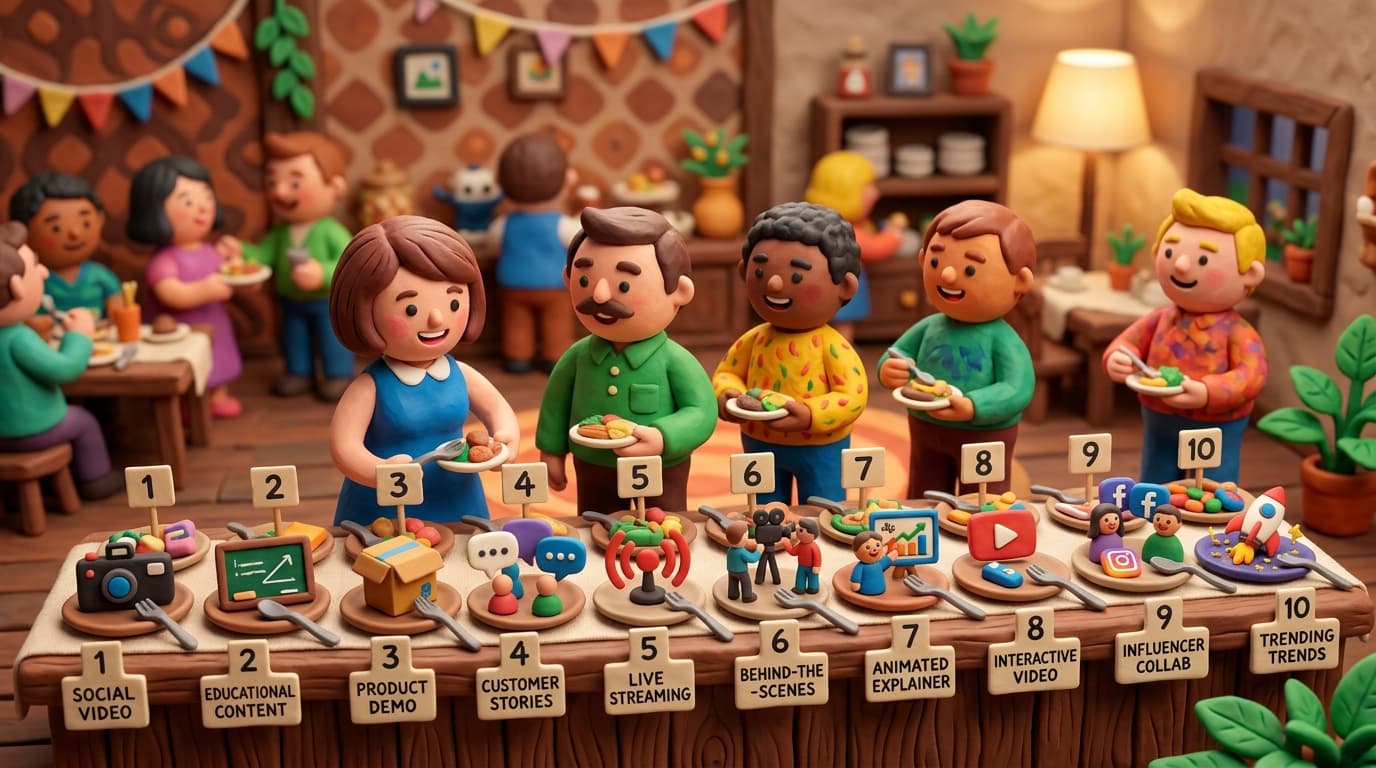
Short-form video under 60 seconds now accounts for 67% of all AI-generated video content, according to recent industry data. That single statistic captures a shift that has been building for two years and reached a tipping point in early 2026: marketers are no longer debating whether to adopt AI video — they are racing to produce more of it, faster, and in shorter formats than ever before.
The numbers behind this shift are striking. The global AI video generator market reached an estimated $847 million in 2026, up from $716.8 million just a year earlier, with projections pointing toward $3.35 billion by 2034. Meanwhile, 21% of marketers now rank short-form video as the highest-ROI content format they produce. What changed? A combination of platform algorithms favoring brevity, AI tools that eliminated production bottlenecks, and audiences that increasingly prefer snackable content over long-form narratives.
Why Short-Form AI Video Exploded in 2026
Three converging forces drove this acceleration, and understanding them matters for any marketing team planning content strategy.
Algorithm Pressure Across Every Platform
TikTok, Instagram Reels, YouTube Shorts, and LinkedIn all continue to prioritize short-form video in their recommendation algorithms. But 2026 introduced a new wrinkle: platforms began rewarding production consistency over viral spikes. Accounts that publish three to five short videos per week now outperform accounts that publish one polished piece monthly, even when the polished piece generates more individual views. This shift penalizes traditional production workflows, where a single 60-second video might take a week from concept to delivery. AI video tools compressed that timeline to hours or minutes, making daily publishing viable for teams of any size.
Production Cost Collapse
AI-powered editing, scripting, voiceover, and generation tools reduced the median video production cost from $4,200 to roughly $2,500 per finished minute, according to industry benchmarks. For short-form content specifically, the economics are even more dramatic. A 30-second animated explainer that would have cost $800-$1,200 through a freelancer or agency in 2024 can now be generated for a fraction of that, often by the same marketer who writes the blog post. This cost collapse removed the biggest barrier to video adoption for startups and small teams operating on tight budgets.
Generation Quality Crossed the Credibility Threshold
The most consequential technical advance has been the leap in generation duration and coherence. What was limited to four-second clips in 2024 expanded to two-minute single-pass generations in 2026, with intelligent segment chaining producing five-minute-plus videos with maintained visual consistency. For short-form content, this means a single generation pass can now produce a complete, publish-ready asset — no stitching, no awkward transitions, no uncanny valley moments that break viewer trust.
The Data Behind the Short-Form Shift
Raw market statistics tell part of the story, but the behavioral data reveals why short-form AI video specifically — not just AI video broadly — is capturing marketing budgets.
Engagement Metrics Favor Brevity
Completion rates for AI-generated videos under 30 seconds average 72%, compared to 34% for videos over two minutes. This gap widened in 2026 as audiences developed sharper filters for content that does not immediately deliver value. The implication is clear: a team producing six 20-second explainers per week will accumulate more total watch time and engagement than a team producing one three-minute video monthly.
Conversion Impact Is Measurable
Landing pages with AI-generated explainer videos convert at 34% higher rates than pages with text alone. But the format matters: product demos and explainer videos represent 31% of all AI video output because they directly tie to revenue outcomes. Short-form variations — 15 to 45 seconds, focused on a single feature or benefit — outperform longer alternatives in ad placements and social feeds where attention is scarce.
B2B Adoption Is Accelerating Fastest
While consumer brands led the initial wave of AI video adoption, B2B companies are now the fastest-growing segment. Enterprise spending on AI video platforms grew 127% year over year in 2025, and early 2026 data suggests that pace is holding. The driver is straightforward: B2B buyers consume content the same way everyone else does, but B2B marketing teams have historically under-invested in video due to cost and complexity. AI tools eliminated both barriers simultaneously.
How Marketing Teams Are Using Short-Form AI Video
The use cases that generate the strongest results share a common trait: they replace static content with motion without requiring a proportional increase in production effort.
Product Feature Highlights
Instead of writing a feature announcement blog post with screenshots, teams generate a 20-second animated walkthrough showing the feature in action. These clips perform well in email campaigns, social feeds, and product documentation. The key is specificity — one feature per video, one clear benefit, one call to understanding. Teams that try to cram multiple features into a single short clip see engagement drop by roughly half.
Customer Testimonial Snippets
Full-length testimonial videos still have their place, but short-form cuts — a single compelling quote animated with supporting visuals — generate higher share rates and work across more channels. A 15-second testimonial clip in an email signature or LinkedIn post creates touchpoints that a three-minute case study video cannot.
Educational Micro-Content
Complex concepts broken into series of 30-second explainers consistently outperform single long-form tutorials in both engagement and knowledge retention. This approach works particularly well for SaaS onboarding sequences, technical product education, and industry thought leadership where the goal is to build authority over time rather than explain everything in one sitting.
Ad Creative Variation
Perhaps the highest-impact use case is generating multiple variations of ad creative for testing. Where a team might have tested two or three video ad concepts per campaign in 2024, AI-generated short-form video makes it practical to test ten or twenty variations, iterating on hooks, visual styles, and messaging angles. Teams running this approach report 40-60% improvements in cost-per-acquisition compared to single-creative campaigns.
What This Means for Marketing Budgets
The budget implications extend beyond simply spending less per video. The shift to short-form AI video is restructuring how marketing teams allocate resources across their entire content operation.
Production Budgets Are Shrinking, But Volume Budgets Are Growing
Teams are not pocketing the savings from cheaper video production. Instead, they are reinvesting in higher volume. A marketing team that previously allocated $5,000 per month to produce one or two professional videos is now spending $3,000 per month to produce fifteen to twenty short-form pieces. The total budget decreased, but the output increased by an order of magnitude.
Specialist Roles Are Evolving
The traditional video production pipeline — scriptwriter, storyboard artist, animator, editor, sound designer — is compressing into fewer roles. "AI video producer" has emerged as a hybrid position that combines prompt engineering, brand voice management, and light editing. This does not mean video specialists are disappearing; rather, their skills are shifting toward creative direction, quality assurance, and strategic planning rather than manual production.
Distribution Is Becoming the Bottleneck
When production was expensive and slow, it naturally throttled output. With AI removing that constraint, the new bottleneck is distribution strategy. Teams that generate twenty videos per week but lack a coherent publishing calendar, platform-specific optimization, or performance measurement framework end up with a content warehouse rather than a content engine. The most successful teams invest as much in distribution planning as they do in production.
The Competitive Landscape Driving Innovation
The surge in AI video capabilities is not happening in a vacuum. Massive investment is fueling a competitive race that benefits marketers directly.
Runway raised $315 million at a $5.3 billion valuation in February 2026, focused on building what they call "world models" for more realistic generation. Synthesia secured a $200 million Series E at a $4 billion valuation, doubling down on avatar-based video for enterprise communication. Mirage, the company behind the Captions app, raised $75 million to expand its AI editing capabilities. These are not speculative bets — they represent billions in combined capital flowing toward making AI video faster, cheaper, and more capable.
For marketers, this competition means that every quarter brings meaningful improvements in output quality, generation speed, and creative flexibility. Tools like Lychee are making animated explainer videos accessible to teams that previously had no video capability at all, compressing what was once a multi-week agency project into a same-day workflow.
The practical impact: marketing teams that adopt AI video tools now will benefit from a capability curve that keeps improving, while teams that wait will face an ever-widening content gap against competitors who started earlier.
What to Watch for in the Next 12 Months
Several developments on the horizon will shape how short-form AI video evolves through the rest of 2026 and into 2027.
Real-Time Personalization at Scale
The next frontier is generating video variants tailored to individual viewer segments automatically. Rather than producing one video and hoping it resonates broadly, platforms are moving toward dynamic generation that adjusts visuals, messaging, and even pacing based on viewer data. Early implementations are already showing 25-40% improvements in engagement compared to generic video.
Platform-Native AI Video Tools
TikTok, YouTube, and Instagram are all building or acquiring AI video generation capabilities directly into their platforms. When creation tools live inside distribution platforms, the feedback loop between content performance and content creation tightens dramatically. Marketers who understand this integration will have a structural advantage.
Quality Standardization
As AI-generated video becomes ubiquitous, audience expectations for quality are rising. The bar for "good enough" AI video in early 2025 — slightly robotic motion, generic visuals, templated layouts — no longer meets viewer expectations. Teams that treat AI video as a commodity rather than a craft will see diminishing returns, while teams that bring creative direction and brand specificity to their AI-generated content will stand out.
Positioning Your Team for This Shift
The transition to short-form AI video is not a future event to prepare for — it is a current reality that rewards early and consistent action. Marketing teams seeing the strongest results share three habits: they publish frequently rather than perfectly, they measure performance at the individual video level rather than the campaign level, and they iterate based on data rather than instinct.
The statistics paint a clear picture: video content is where audience attention lives, short-form is where algorithms direct that attention, and AI is what makes the production economics work. Teams that align their content strategy with all three of these forces are building a compounding advantage that becomes harder for competitors to close with each passing quarter.