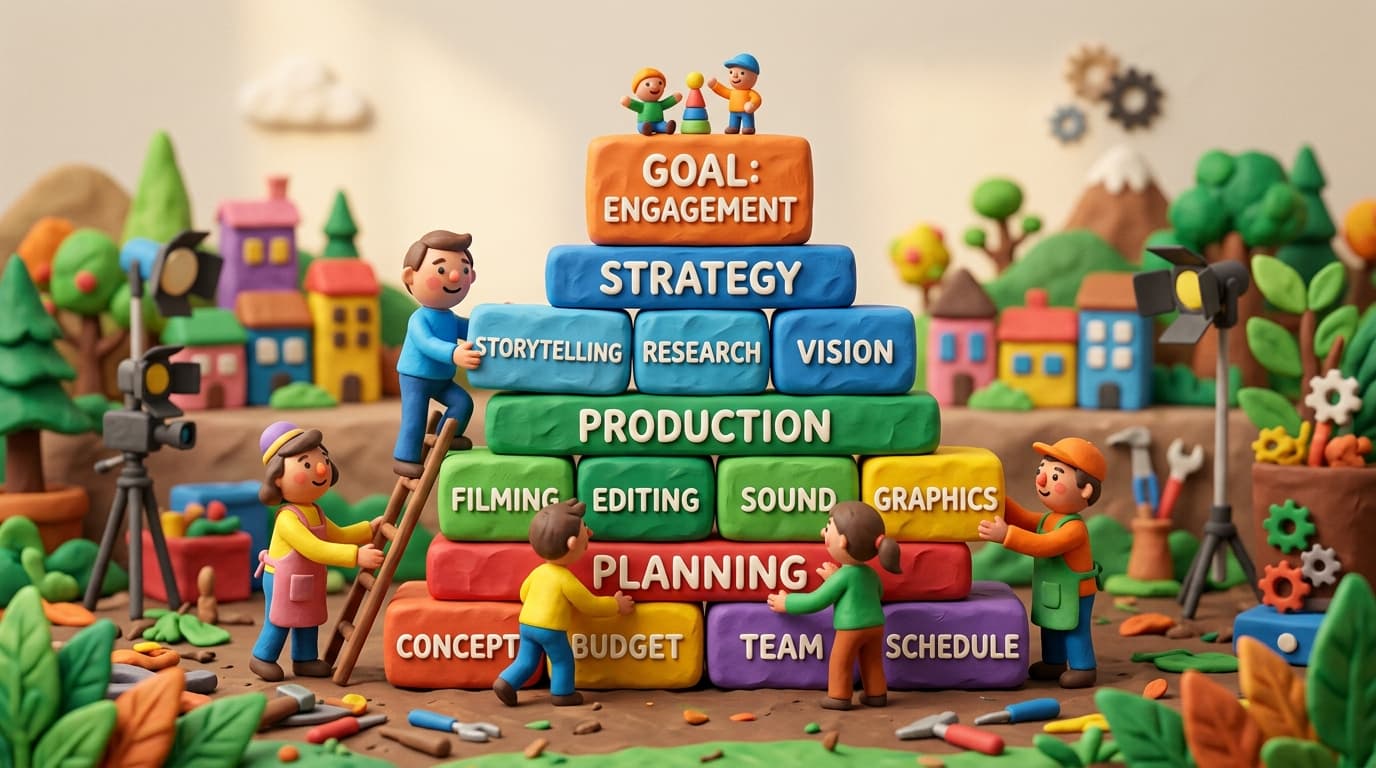
Most marketing teams treat video the same way they treated mobile in 2012: as an afterthought. They write blog posts, design slide decks, draft email copy, and then wonder whether any of it should also be a video. The result is predictable. Video becomes the format nobody has bandwidth for, the line item that gets cut, the "nice-to-have" that never ships.
That approach no longer works. YouTube overtook Reddit as the top-cited source in AI-generated answers in early 2026, according to analysis from eMarketer, as large language models increasingly prioritize video transcripts and metadata for citation. Meanwhile, 91% of businesses now use video in their marketing, per Wyzowl's latest survey, and teams adopting AI video tools report an average 4.2x return on investment within their first six months.
The shift is clear: video is no longer a supporting format. It is the primary medium through which audiences discover, evaluate, and decide. Building a video-first content strategy means restructuring how your team plans, produces, and distributes content so that video comes first and everything else derives from it.
What Video-First Actually Means
A video-first strategy is not about producing more videos. It is about changing the order of operations. Instead of writing a blog post and then considering whether to make a video version, you start with the video and derive the blog post, social snippets, email content, and sales collateral from it.
This reversal matters for three reasons.
Video captures more signal. A two-minute explainer contains tone, pacing, visual metaphors, and narrative structure that a 1,000-word article cannot replicate. When you start with video, you capture the richest version of your idea first.
Derivation is cheaper than origination. Transcribing a video into a blog post takes minutes. Writing a blog post and then producing a video from it takes hours. The video-first workflow naturally reduces total production time.
Discovery favors video. Search engines, social algorithms, and AI assistants all prioritize video content. Building your strategy around the format that gets the most distribution leverage is a structural advantage.
The Core Principle: Create Once, Derive Many
Think of each video as a content seed. A single three-minute explainer video can yield:
- A blog post (from the transcript, restructured for readers)
- Three to five social clips (vertical cuts for Reels, Shorts, TikTok)
- An email newsletter segment (key insight with a video embed)
- A sales enablement asset (the full video for prospect follow-up)
- A slide deck excerpt (key frames with narration notes)
This is different from repurposing existing content into new formats. Repurposing starts anywhere and adapts. Video-first starts deliberately with video and cascades outward.
Choosing the Right Video Formats by Platform
Not every video works everywhere. A video-first strategy requires matching format to platform from the moment you plan a piece of content.
Short-Form Discovery (15-60 Seconds)
Short-form vertical video drives the highest engagement rates across platforms. Videos under 60 seconds generate 2.5x more engagement per impression than longer formats, according to Sprout Social's 2026 benchmarks. Use these for:
- TikTok and Instagram Reels: Hook-driven clips that surface a single insight, stat, or demonstration. These are top-of-funnel discovery assets designed to reach new audiences through algorithmic distribution.
- YouTube Shorts: Similar format but optimized for YouTube's recommendation engine. Shorts viewers often convert to long-form subscribers, making them an effective bridge format.
- LinkedIn short video: Professional context changes the content calculus. A 30-second clip explaining a framework or sharing a data point performs well here because it delivers value without demanding a time commitment.
Mid-Form Education (1-5 Minutes)
This is where animated explainer videos excel. Mid-form content is long enough to teach something meaningful but short enough to hold attention. Deploy these as:
- Product explainers: Walk through a feature, workflow, or use case in enough detail that a prospect understands the value without a sales call.
- How-to tutorials: Teach your audience something adjacent to your product. If you sell project management software, teach stakeholder communication techniques.
- Customer stories: Narrate a customer's problem and solution in a structured, visual format that prospects can see themselves in.
Long-Form Authority (5-20 Minutes)
Long-form video builds authority and captures search traffic. YouTube remains the second-largest search engine, and long-form content with proper metadata ranks for informational queries that blog posts struggle to capture.
- Deep-dive tutorials: Comprehensive walkthroughs that become reference material. These generate sustained organic traffic for months.
- Industry analysis: Commentary on trends, data, and market shifts positions your brand as a thought leader.
- Webinar recordings: Edited and optimized for on-demand viewing with chapters and timestamps.
Building an AI-Powered Production Workflow
The reason video-first was impractical for most teams before 2026 is simple: production was expensive, slow, and required specialized skills. AI has changed each of those constraints.
Step 1: Script and Storyboard
Start with a clear brief. Define the audience, the single key message, and the desired action. Then draft a script. AI writing assistants can generate a working first draft in seconds, but the strategic decisions (what to say, what to emphasize, what to cut) remain human work.
For animated explainer videos, storyboarding matters more than scripting. Map each scene to a visual concept. This is where tools like Lychee can accelerate the process, translating scripts into animated scenes without manual illustration.
Step 2: Production
AI video generation has split into two practical lanes:
Animated explainers: Best for product demos, concept explanations, and educational content. These are brand-safe, fully controllable, and do not require actors, locations, or equipment.
Live-action enhancement: AI handles editing, color correction, captioning, and format adaptation. The footage is human-shot, but post-production is largely automated.
For a lean marketing team running a video-first strategy, animated explainers are the higher-leverage format. They are faster to produce, easier to update when messaging changes, and consistent in quality regardless of production volume.
Step 3: Derivation
Once the primary video exists, derive your secondary content:
- Transcript extraction: Pull the full text and restructure it into a blog post with headers, links, and expanded context.
- Clip cutting: Identify the two or three most compelling moments and cut them into short-form vertical videos. Add captions, since 85% of social video is watched without sound.
- Visual extraction: Pull key frames for use in email headers, social cards, and presentation decks.
- Audio extraction: Strip the audio for podcast feeds or internal knowledge bases.
Step 4: Distribution
Publish the primary video on its home platform (usually YouTube for long-form, TikTok or Instagram for short-form). Then roll out derived content across channels over the following days. Stagger your releases to maintain consistent presence without flooding any single channel.
For detailed guidance on scheduling and cadence, see our guide on building a video content calendar with AI.
Measuring Video-First Performance
Video-first demands different metrics than text-first marketing. The measurements that matter depend on the format and the funnel stage.
Discovery Metrics
- View count and reach: How many people saw your content. This is a vanity metric in isolation but useful for benchmarking awareness campaigns.
- Engagement rate: Likes, comments, shares, and saves as a percentage of views. This indicates whether your content resonates enough to prompt action.
- Watch-through rate: The percentage of viewers who watch to completion. For short-form, target above 60%. For mid-form, above 40%.
Conversion Metrics
- Click-through rate: How many viewers take the next step (visiting a landing page, signing up for a trial, booking a demo).
- Assisted conversions: Video rarely operates as a last-touch channel. Track how video views appear in multi-touch attribution models to understand their true contribution.
- Pipeline influence: For B2B teams, map video engagement to pipeline creation and deal progression in your CRM.
Efficiency Metrics
- Content velocity: How many pieces of content does your team produce per week? A video-first workflow should increase this number because derivation is faster than origination.
- Cost per asset: Total production cost divided by the number of distinct content pieces generated from each video. This is where video-first shines, since one production effort yields five to ten assets.
- Time to publish: How quickly can your team go from idea to live content? AI-powered workflows should compress this from weeks to days.
Common Mistakes to Avoid
Treating Every Platform the Same
A three-minute horizontal explainer does not belong on TikTok. A 15-second clip with no context does not belong on YouTube. Format each derivative for the platform where it will live. This means different aspect ratios, different hooks, different pacing, and sometimes different messaging emphasis.
Skipping the Strategy Layer
AI makes production fast, but speed without direction produces noise. Before you start generating videos, define your content pillars, your audience segments, and your distribution channels. A video-first strategy without a strategy is just a video factory.
Over-Automating the Creative
The research supports a "human-in-the-loop" approach. According to data from LTX Studio, 71% of creators use AI for first drafts and refine manually. AI handles assembly, pacing, and initial editing. Human judgment handles creative direction, brand tone, and final polish. Teams that fully automate without creative oversight see diminishing returns as content becomes generic and interchangeable.
Ignoring the Feedback Loop
Every video generates data: where viewers drop off, which clips get shared, which topics drive conversions. Feed this data back into your planning process. The most effective video-first teams review performance weekly and adjust their content calendar based on what the audience actually responds to.
Getting Started: A 30-Day Video-First Transition
If you are currently running a text-first or channel-first marketing strategy, here is how to transition to video-first in 30 days.
Week 1: Audit and plan. Review your top-performing content from the past quarter. Identify the five topics that generated the most engagement or conversions. These become your first five video topics.
Week 2: Produce your first batch. Create two to three videos using your chosen production method (animated explainers, screen recordings, or AI-generated content). Focus on mid-form educational content that maps to high-intent search queries.
Week 3: Derive and distribute. Extract blog posts, social clips, and email content from each video. Publish across your channels on a staggered schedule. Track initial performance.
Week 4: Measure and iterate. Review watch-through rates, engagement, and conversion metrics. Identify what worked and what missed. Adjust your topic selection and format choices for the next month.
The goal is not perfection in month one. It is building the muscle of thinking video-first: planning around video, producing video as the primary asset, and deriving everything else from it.
The Strategic Advantage
The gap between teams that treat video as an afterthought and teams that build their strategy around it is widening. AI has removed the production barriers that made video-first impractical for lean teams. The remaining barrier is strategic: deciding to make the shift.
Marketing teams that commit to video-first gain compounding advantages. Their content reaches more surfaces, captures richer audience data, and builds stronger brand associations than text alone. And because AI-powered workflows reduce the marginal cost of each additional piece of content, the strategy becomes more efficient at scale, not less.
The question is no longer whether your team can afford to go video-first. It is whether you can afford not to.